

In just over three years, it’s estimated that more than two billion people worldwide will have presbyopia.1 This statistic alone points to a significant and growing population of patients who will require presbyopic correction as their near vision diminishes with age.
With presbyopia treatment options continuing to expand, soft multifocal contact lenses remain an excellent option for both new and established wearers.2
Considering prescribing habits, multifocal fits are rising at a steady rate.3 A recent international survey-based study reported that soft multifocal contact lens prescriptions have doubled over the past 2 decades.3 This growing trend may be of no surprise, since modern multifocal contact lenses are available in a wide range of parameters, materials, and replacement frequencies.1,3
Key Deliverables in Multifocal Designs
Patients with presbyopia across all refractive errors prefer contact lens correction when good vision and comfort can be achieved.4 Further, a study by Guthrie et al. suggests visual needs may top the list of multifocal deliverables when it comes to patient retention and long-term wearing success.5
Focusing on multifocal optics, aspheric center-near multifocal contact lenses are generally well accepted in patients with presbyopia.6,7 However, individuals with advanced presbyopia have often experienced poorer visual performance in multifocal contact lenses with aspheric designs.8
CooperVision’s technological innovations have bridged this gap with the Binocular Progressive System™, an innovative 3 Add design that caters to all levels of presbyopia,9 explains Tara Vaz, OD, FAAO, Senior Advisor, Core Portfolio & Cornea Care, U.S. Professional Affairs, CooperVision.
“What makes the Binocular Progressive System™ unique is that it's designed to support how the two eyes work together across all stages of presbyopia.9 Rather than taking a one-size-fits-all approach, the design evolves to help patients maintain clear, functional vision as their visual needs change,” Dr. Vaz says.9
The Binocular Progressive System™ also offers a simple fitting process for eye care professionals (ECPs) while meeting the changing near vision needs of patients as their presbyopia advances, she continues.9
Meeting Presbyopic Vision Needs at All Stages9
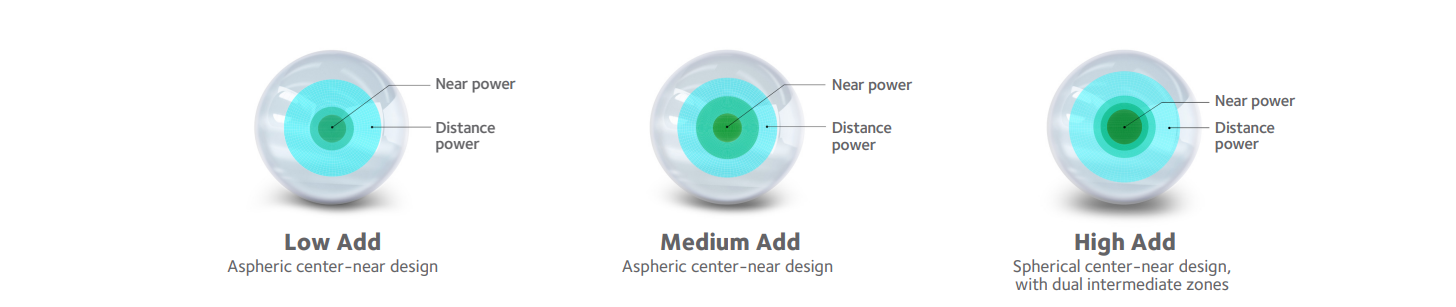
Found in both MyDay® multifocal and clariti® 1 day multifocal 3 Add, the Binocular Progressive System™ delivers optimal vision at every distance and every stage of presbyopia:9
- Early presbyopia: The system combines two low Add aspheric center-near lenses with a wide distance area and optical progression to the reading area, which is ideal for maintaining clear distance vision when transitioning into multifocal contact lenses.
- Advancing presbyopia: The dominant eye keeps a low-Add design for clear distance, while the non-dominant eye uses a medium-Add design with a widened and strengthened central reading area.
Later stage presbyopia: The system combines the wide, clear distance vision of the low Add lens with a high Add lens designed with a single powered, spherical center near zone and dual intermediate power zones. For the spherical center near design with dual intermediate power zones, a single powered central reading zone is provided for those wearers who need the most help with their near vision.

Seamless, Easy Fits for Patients and Practitioners10
The Binocular Progressive System™ was also designed to help simplify the fitting process for ECPs while supporting patients throughout their presbyopia journey, Dr. Vaz says.10
“We know that patients expect a straightforward fitting process and don’t want to sit through long, repeated appointments,” she notes. “The Binocular Progressive System™ fitting guide was developed and validated through clinical studies to make the fitting process straightforward, helping practitioners achieve successful outcomes without unnecessary chair time.”10
The 3 easy fitting steps include:
- Start with an up-to-date refraction.
- Determine ocular dominance. Use the +1.00D blur method. If inconclusive, use the sighting method.
- Select trial lenses. The fitting guide always directs the low Add to the dominant eye, while the non-dominant eye receives either a low, medium or high Add based on the near addition.
Of note, the fitting guide can help ECPs achieve a 98% fit success rate with two pairs or fewer.*9
To simplify the fitting process even further, ECPs can turn to the OptiExpert® App.†‡ The prescription calculator supports CooperVision® soft contact lens fitting, including MyDay® multifocal and clariti® 1 day multifocal 3 Add, even before the first lens is placed on eye. ECPs or staff can enter the up-to-date subjective refraction and vertex distance in the OptiExpert® App, and it will suggest the prescription for all lens options available.
Rely on the Comfort of CooperVision Soft Multifocal CLs9,11
As previously noted, comfort is another key factor that patients with presbyopia want from their multifocal contact lenses.
In both MyDay® multifocal and clariti® 1 day multifocal 3 Add, the Binocular Progressive System™ is paired with naturally wettable silicone hydrogel material9 technologies to help support wearer comfort throughout the day.9,11
- MyDay® multifocal leverages Aquaform® Technology, an innovative material technology that hydrates contact lenses to twice their weight in water9 for natural wettability and incredible comfort.9
- WetLoc® Technology, found in clariti® 1 day multifocal 3 Add, creates a naturally wettable contact lens9 that ensures the lens surface is moist during the day with locked in water evenly spread throughout.10
Patient Perceptions of CooperVision’s Soft Daily Disposable Multifocals
“As presbyopia progresses, patients often become increasingly aware of the impact it has on their everyday activities, whether that's reading, using digital devices, or enjoying hobbies,” says Dr. Vaz. “When practitioners can provide a contact lens that delivers both vision and comfort, it can make a meaningful difference in the patient experience.”
Here’s what patients have to say about MyDay® multifocal and clariti® 1 day multifocal 3 Add:
- MyDay® multifocal provides good overall vision satisfaction with a rating of approximately 80 out of 100.12
- 83% of patients say MyDay® multifocal offers good levels of comfort after one week of daily wear.12
- clariti® 1 day multifocal 3 Add provides very good vision satisfaction at fitting, overall, and at distance, intermediate and near.13
- Previous clariti® 1 day multifocal 2 Add wearers refit into clariti® 1 day multifocal 3 Add rated their new contact lenses highly satisfying for overall comfort.§10,14
Find Out More
Discover more about The Binocular Progressive System™ in this white paper or by visiting CooperVision’s Online Success Center. And learn more about MyDay® multifocal and clariti® 1 day multifocal 3 Add for your patients with presbyopia.


