

It’s estimated that most U.S. adults will spend 90,000 hours, or one-third of their waking lives, at work.1,2 Considering the amount of time spent on the job, an individual’s work environment can hold considerable sway when it comes to their job satisfaction and even lead to their employer’s overall success.1-4
For example, studies have found that individuals who work in settings that offer a positive workforce culture are happier and more collaborative, while the employers reap the benefits of increased productivity and employee retention.1-4
But what exactly are the hallmarks of a positive workforce culture, and how can an optometric practice create and foster one?
A thriving workforce culture is the lived, daily experience of what it feels like to work inside a practice. As Heidi Bell, OD, FAAO, FCOVD, explains, culture is the personality of the organization: the values, behaviors, communication patterns, and relationships that shape how people show up each day. At her Elite Eye Care practice, that personality is unmistakable.
From the moment staff gather at 7:15 a.m. for a choreographed “brain gym” vision therapy dance to a Pitbull song, to the large value‑driven signs displayed in hallways and breakrooms, Elite Eye Care’s culture is visible, intentional, and deeply felt.
“These values aren’t just something that we hope happens, they’re something that we have intentionally chosen and built over time,” Dr. Bell says.
1. Live the Practice’s Values Every Day
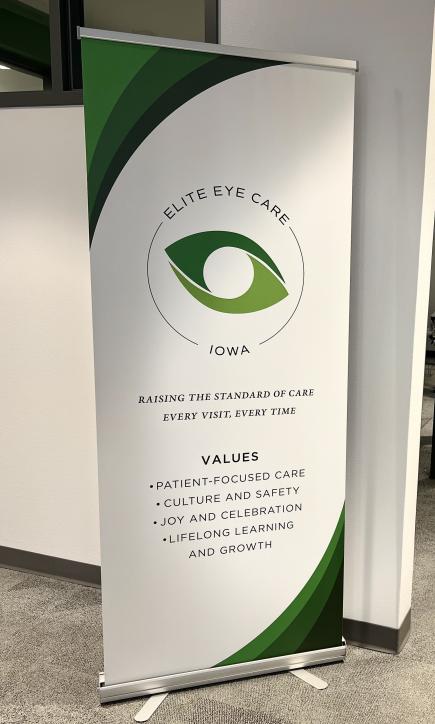
Elite Eye Care’s values: patient‑focused care, culture and safety, joy and celebration, and lifelong learning and growth, are displayed prominently at the practice entrance and throughout staff spaces. These values guide everything from hiring to daily interactions, Dr. Bell notes.
The practice prioritizes psychological safety, trust, and collaboration. Team members are encouraged to share ideas, ask questions, make mistakes, and contribute to improvements regardless of their role.
“We believe that you can be a leader at any level,” Dr. Bell says. “Some of our best ideas come from the team members who are closest to the work and the patient experience.”
Elite Eye Care backs this philosophy with structure that includes leadership development, ongoing learning, a four‑day work week, competitive benefits, and regular feedback. Wins are celebrated frequently, innovation is encouraged, and the environment is designed to help people feel both challenged and supported.
“Most importantly, we genuinely care about improving our teams’ lives, not just their performance at work,” Dr. Bell says.
Elite Eye Care shares its values outside of the clinic’s walls too. A few recent examples include staff’s and doctors’ participation in a volunteer clinic that served 520 patients over two days and the team rolling up their sleeves to support a Habitat for Humanity build.
2. Establish Routines That Reinforce Culture
Monthly team meetings are a signature example of Elite Eye Care’s culture in action. With more than 75 team members, the meetings are infused with celebration, enthusiasm, and connection. During a recent birthday month for Dr. Bell, every table was themed around her favorite things, complete with trivia and games.
Meetings begin with birthdays and announcements and end with shoutouts or kudos where team members call out colleagues for kindness, excellence, or meaningful impact. And of course, no meeting is complete without the brain gym vision therapy‑based dance that has become a beloved tradition, even making an appearance at a colleague’s wedding reception.
On the clinical side, problem‑solving is collaborative and empowering. For example, when a team member identifies a gap, leadership doesn’t prescribe a solution but asks for ideas. “We tell our team that if we’re doing things the exact same way a year from now, we’re not doing it right,” Dr. Bell says.
3. Create Culture that Resonates with Patients
Patients may not articulate it, but they sense culture immediately. A team that communicates well, enjoys working together, and genuinely cares creates a smoother, more coordinated experience, especially for patients at her practice with complex visual conditions, brain injuries, ocular disease, or specialty contact lens needs, Dr. Bell says.
These patients frequently require collaboration between multiple departments and providers, she explains. Because her team communicates openly and supports one another, patients experience a smoother, more coordinated journey through care.
“Many patients comment that our offices feel different. They describe feeling welcomed, heard, and cared for. That experience doesn’t happen because of one individual. It is the direct result of a strong team culture,” Dr. Bell continues.

4. Foster Retention Built on Respect and Trust
Elite Eye Care’s staff retention rate is a remarkable 90%, a number that speaks for itself. While compensation and benefits matter, Dr. Bell believes culture is the true differentiator. “People want to work somewhere they feel respected, trusted, and valued,” she says.
The practice also celebrates longevity in meaningful ways. To honor their commitment and contributions, two team members who reached 10‑ and 15‑year work anniversaries this year were awarded with trips with their spouses. “It was so fun to celebrate these individuals and all they’ve given back to us over the years and in such a big way,” Dr. Bell says.
Looking at the big picture, retention isn’t about convincing people to stay, Dr. Bell notes. “It’s about creating an environment where they don’t want to leave.”
5. Build Culture for the Long-Term
As Elite Eye Care has grown to multiple locations and a much larger team, maintaining culture has required intentionality. Hiring, onboarding, leadership development, communication, and accountability all play critical roles.
“I’m always thinking ahead of how we can continue to grow what we’re doing in meaningful ways and not get complacent,” Dr. Bell says. “I now know that culture isn't a one-time initiative that you declare on the first day the clinic opens. It’s a really slow intentional build that is reflected in how you show up yourself as the owner, the doctor and a leader in the clinic. If you don’t like the culture of your current space, you can really look at yourself and how you’re showing up. It’s hard to change an entire organization, but personally, starting with myself seemed to have a ripple effect.”
One final lesson that Dr. Bell has learned is that culture isn’t about keeping everyone happy. It’s about clarity, trust, accountability, and shared purpose, she says.
“The healthiest cultures aren’t the ones without challenges,” she adds. “The healthiest workforce cultures are the ones where people feel safe working through challenges together. I know that we have a team and a culture that can do that.”

Dr. Heidi Bell, OD, FAAO, FCOVD, graduated from Iowa State University with honors and received her Doctorate of Optometry from Southern College of Optometry. She furthered her training through a Residency in Primary Care Optometry, spending her time serving under-served populations in various public health settings in Memphis, TN.
Dr. Bell is a Fellow in the American Academy of Optometry and is a Board Certified Fellow of the College of Optometrists in Vision Development (COVD). In 2015, Elite Eye Care began what is now Elite Vision Therapy, which provides non-invasive therapeutic services for patients with binocular vision dysfunction, amblyopia, strabismus and traumatic brain injuries (TBI). Dr. Bell is passionate about children’s eye care and vision rehabilitation. Aside from primary eye care and pediatric eye care, she enjoys treating patients with amblyopia, strabismus and learning related vision issues. She also enjoys pediatric contact lenses and myopia control.


