
In less than four years, it’s projected that nearly 50% of individuals living in North America will have myopia.1 Throwing the net even wider, the big picture tells us that myopia and high myopia rates are escalating at home, abroad, and notably in children.1,2
With myopia on the rise seemingly wherever you look,1,2 it’s no surprise that the myopia education and prevention arena has expanded, including the addition of big tech and its mighty megaphone reach.
This June will mark Apple’s third year in the myopia space. Whether you’re hearing about it for the first time or need a recap, here’s a look at Apple’s vision health features, what science says about their purported end goals, and how big tech’s move into myopia education and mitigation fits into the overall quest of spreading the myopia awareness message far and wide.
Outdoor Time & Screen Distance Prompts
Before we get into the tech, let’s walk back to the beginning. In 2023, Apple made headlines with the launch of its new vision health features in its iOS 17, iPadOS 17, and watchOS 10 systems. During a 2023 Apple Worldwide Developers Conference, Apple’s leadership said an important area of the company’s new technology focus was eye health, and specifically the reduction of myopia.3
Citing stats about myopia’s growing prevalence worldwide,1 Apple introduced the eyehealth features that the company said could encourage healthy behavior and lower a child’s myopia risk.3 These include:
1. More time spent in daylight.
With the International Myopia Institute recommending children spend at least 80-120 minutes a day outdoors,4 Apple’s “Time in Daylight” feature monitors how much time users spend outdoors each day. This is done via the ambient light sensor on an iPhone or Apple Watch. Children who don’t have their own iPhone can use “family setup” to pair their Apple Watch to their parent’s iPhone, which gives parents visibility into the amount of time their kids are spending in daylight.
2. Increased viewing distance during near work activities like digital device use and reading.
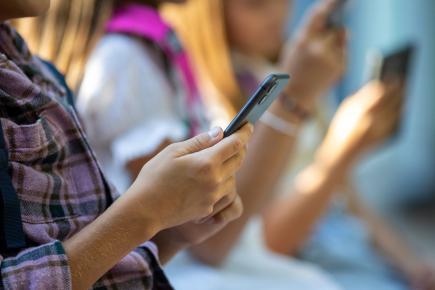
Apple’s “Screen Distance” feature measures the distance between a device and the user’s face through a built-in camera on the iPhone and iPad. The feature alerts users if the device is held closer than 12 inches from their face for too long. Moving the device further away prompts a message to choose a better distance. The Screen Distance feature uses the same TrueDepth camera that powers Face ID on the iPhone and iPad. Screen Distance can remind younger users to engage in healthy viewing habits that may help lower their risk of myopia, and it gives adult users the opportunity to reduce digital eyestrain, the company said.5
“We are thrilled to provide new ways to track and manage vision health,” Apple’s leadership said during the conference.3
Myopia Tech vs. Real Science
On paper, Apple’s intent behind its myopia features is backed by numerous studies and counting.
1. The link between time spent outdoors and myopia risk.
One investigation found increased outdoor time reduced the risk of myopia onset and myopic shifts, especially in nonmyopic children.6 Another study that included 693 first graders in Taiwan found students who had been encouraged to spend at least 11 hours per week outside had less myopic shift and axial elongation compared to children in the control group.7 Further, a paper, “Outdoor Activity Protects Against Childhood Myopia—Let the Sun Shine In” by Zadnick, et. al. found that 14 hours per week spent outdoors could mitigate a child’s risk of becoming nearsighted.8
2. The link between prolonged near work and myopia.
Multiple studies have pinpointed working distances shorter than 20 to 30 centimeters as an increased risk for myopia.9-12
One systematic review showed that near work activities were associated with myopia and that increased “diopter hours” of near work might increase myopia prevalence by 2% for every one diopter-hour more of near work per week.10 Finally, a systematic review and dose-response meta-analysis found a daily 1-hour increment in digital screen time was associated with 21% higher odds of myopia, and the dose-response pattern indicated a potential safety threshold of less than 1 hour per day of exposure, with an increase in odds up to 4 hours.11
Apple’s Myopia Features: Help or Hype?
Now that we’ve walked through Apple’s myopia tech health additions and considered whether they pass science’s truth test, are these features a helpful tool or merely hype? Rupa Wong, MD, tackled this topic recently and added some clear insight.
Unlike genetic risk for myopia,13 increased time spent outdoors and monitoring time on near work activities are modifiable lifestyle risk factors,1,5-9 Dr. Wong says.
“These health features have research to back them up, and I’m really excited to see Apple becoming an advocate for reducing near sightedness in kids and young adults. I like that we’re now starting to see these big tech companies whose products foster a lot of dependence on close up screentime doing their part to trying to help mitigate that,” she says.
Final Take
Wherever you stand on big tech’s entry into the myopia space, the primary education source for a parent and their child should always be the eye care professional (ECP). While tech can help, it can’t prescribe treatments, build doctor-patient relationships, or provide comprehensive care that puts the child with myopia first and foremost.
That role will also belong to the eye care professional. Myopia is such a big problem that it will take all of us to bring efficacious solutions to the patients living in our communities. Leave no child behind. Start by helping one each day.


