




Child with Blurred Vision

Know the Signs of Myopia

Is your child having trouble seeing the board in school, squinting when looking at distant objects, or experiencing blurred vision or headaches? These could be signs of myopia, also known as nearsightedness, which often first appears in school-age children and progresses until about age 20.  In fact, a recent study showed a 41% prevalence of myopia in children ages 5-19 years old†2, due in part to changing lifestyles and less time outdoors.3-5

Since myopia makes faraway objects appear blurry, children may have more difficulty participating in sports, school, and other daily activities.6,7 Without myopia management, their worsening condition often results in increased dependence on glasses or contact lenses for everyday tasks.6,7

This is crucial because slowing the rapid progression of myopia is just as important as correcting vision itself.8 Until recently, the myopia diagnosis often meant an ongoing need for progressively stronger glasses as the child’s vision worsened with age. However, advancements in vision care now offer solutions not just to clear vision, but also to help slow down myopia progression. This is crucial because slowing the rapid progression of myopia is just as important as correcting vision itself.8
 

Treating for the Short Term and Long Run

When your child is diagnosed with a medical condition, immediate treatment is essential to help prevent it from worsening. The same urgency should be applied to addressing nearsightedness in age-appropriate children.

The immediate obstacles pale in comparison to the increasing problems myopia can cause later in life, like glaucoma, retinal detachment or early development of cataracts.9-12 Early treatment is mission critical: addressing myopia at the onset can slow its progression and help protect a child’s myopia levels from getting worse later in life.*‡§1,13 That’s why the steps you take today are important.

Not all parents are familiar with myopia—only 53% of parents can define the term,¶15 but if you’re reading this, you aren’t one of them! Once you better understand the condition, you can arm yourself with knowledge about what you can do for your child. Once myopia gets worse, you cannot go back.
 

How to Help Keep Myopia From Getting Worse

The good news is, there are ways to help slow the progression of myopia—in addition to helping your child see clearly. Eye care professionals recommend spending more time outdoors, reducing screen time, and modifying how close kids are to their screens.14

Dr. Justin Kwan, OD, FAAO, Senior Manager of Myopia Management at CooperVision, recommends taking children on errands and to the park to help reduce the risk of developing myopia. Even in that short time, they’ll be outside a little more than they would be otherwise.

When it comes to clearing up blurry vision and helping to control your child’s nearsightedness, it’s also important to choose the right products. Standard glasses will only correct your child’s vision, not slow the progression of myopia. Early intervention with myopia management disrupts that process, in a good way! That’s why 92% of eye care professionals agree it’s important to address children’s eye conditions and slow myopia progression at an early age—ideally before they turn 10.15
 

Your Child Has Myopia—Now What?

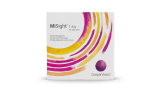
Learn about myopia and make an appointment with a MiSight® 1 day* eye doctor who can offer myopia management treatments for your age-appropriate child.

Your doctor can recommend products that fit into your child’s life. Traditional glasses and contact lenses in the U.S. were developed only to correct blurred vision. That all changed with the introduction of MiSight® 1 day contact lenses. These daily wear single-use contact lenses are the first FDA-approved* product to slow the progression of myopia in children aged 8-12 years old at the initiation of treatment.|1

It's no surprise that 97% eye care professionals that prescribe MiSight® 1 day agree fitting age-appropriate children with myopia in MiSight® 1 day contact lenses will have a positive impact on their patient’s long-term vision health.¶16 In a 3 year study, over 90% of parents whose age-appropriate children were wearing MiSight® 1 day also rated their child ‘happy’ with the overall experience of wearing contact lenses.**17  And maybe most importantly, 9 out of 10 of age-appropriate children expressed a strong preference for MiSight® 1 day over their glasses after 3 years of wear.18

Ready to take the next step? Learn more about myopia and find a MiSight® 1 day eye doctor near you.

Sign up for new information about MiSight® 1 day.


Indications and Important Safety Information.
Rx only.
Results may vary.
ATTENTION: Reference the Patient Information Booklet for a complete listing of Indications and Important Safety Information. Indications: MiSight® 1 day (omafilcon A) soft (hydrophilic) contact lenses for daily wear are indicated for the correction of myopic ametropia and for slowing the progression of myopia in children with non-diseased eyes, who at the initiation of treatment are 8-12 years of age and have a refraction of -0.75 to -4.00 diopters (spherical equivalent) with ≤ 0.75 diopters of astigmatism. The lens is to be discarded after each removal. Warnings: Problems with contact lenses could result in serious injury to the eye. Do not expose contact lenses to water while wearing them. Under certain circumstances MiSight® lenses optical design can cause reduced image contrast/ghosting/halo/glare in some patients that may cause difficulties with certain visually-demanding tasks. Precautions: Daily wear single use only. Patient should always dispose when lenses are removed. No overnight wear. Patients should exercise extra care if performing potentially hazardous activities. Adverse events: Including but not limited to infection/inflammation/ulceration/abrasion of the cornea, other parts of the eye or eyelids. Some of these adverse reactions can cause permanent or temporary loss of vision. If you notice any of the stated in your child, immediately have your child remove the lenses and contact your eye care professional.


Collapse
* INDICATIONS AND BRIEF SAFETY INFORMATION for MiSight® 1 day soft contact lens:

INDICATIONS:
MiSight® 1 Day (omafilcon A) Soft (Hydrophilic) Contact Lenses for Daily Wear is a prescription device indicated for the correction of nearsightedness and for slowing the progression of nearsightedness in children with non-diseased eyes, who at the initiation of treatment are 8-12 years of age and have a refraction of -0.75 to -4.00 diopters (spherical equivalent) with ≤ 0.75 diopters of astigmatism

BRIEF SAFETY INFORMATION:

Rx only; results may vary.

ATTENTION: Reference MiSight.com/safety for a complete listing of Indications and Important Safety Information.

INDICATIONS: MiSight® 1 day (omafilcon A) soft (hydrophilic) contact lenses for daily wear are indicated for the correction of myopic ametropia and for slowing the progression of myopia in children with non-diseased eyes, who at the initiation of treatment are 8-12 years of age and have a refraction of -0.75 to -4.00 diopters (spherical equivalent) with ≤ 0.75 diopters of astigmatism.  The lens is to be discarded after each removal.

WARNINGS: Problems with contact lenses could result in serious injury to the eye.  Do not expose contact lenses to water while wearing them.  Under certain circumstances MiSight® lenses optical design can cause reduced image contrast/ghosting/halo/glare in some patients that may cause difficulty with certain visually-demanding tasks.

PRECAUTIONS: Daily wear single use only.  Patient should always dispose when lenses are removed.  No overnight wear.  Patients should exercise extra care if performing potentially hazardous activities.

ADVERSE EVENTS: Including but not limited to infection/inflammation/ulceration/abrasion of the cornea, other parts of the eye or eyelids.  Some of these adverse reactions can cause permanent or temporary loss of vision.  If you notice any of the stated in your child, immediately have your child remove the lenses and contact your eye care professional.

‡‡ National rebate: *Available on purchases between 1/1/26-12/31/26. Must submit rebate form within 60 days of lens purchase.

* Indications for use: MiSight® 1 day (omafilcon A) soft (hydrophilic) contact lenses for daily wear are indicated for the correction of myopic ametropia and for slowing the progression of myopia in children with non-diseased eyes, who at the initiation of treatment are 8-12 years of age and have a refraction of -0.75 to -4.00 diopters (spherical equivalent) with ≤ 0.75 diopters of astigmatism. The lens is to be discarded after each removal.
† Eligible patients were 5- to 19-years old between January 1, 2008, through December 31, 2013, and received an ophthalmologic or optometric refraction. Electronic medical records were reviewed for demographic data, refraction results, and exercise data. Prevalence and relative risks of myopia (defined as ≤-1.0 diopter) were characterized. 
‡ ActivControl® technology in MiSight® 1 day contact lenses slows axial length elongation and corrects refractive error for age-appropriate children.
§ MiSight® 1 day shows sustained slowing of eye growth over time on average. While eyes are still growing; children fit ages 8-12 and followed for 6-years. n=40.
| Compared to a single vision 1 day lens.
¶ 77% strongly agree, 20% somewhat agree.
** Overall experience as defined as children's comfort, vision, lens handling, and freedom from spectacles. Children aged 8-15 years.

References:

1 Chamberlain P, et al. A 3-year randomized clinical trial of MiSight® lenses for myopia control. Optom Vis Sci. 2019; 96(8):556-567.
2 Theophanous C, Modjtahedi BS, Batech M, Marlin DS, Luong TQ, Fong DS. Myopia prevalence and risk factors in children. Clin Ophthalmol. 2018;12:1581-1587 https://doi.org/10.2147/OPTH.S164641.
3 Xiong S, Sankaridurg P, Naduvilath T, Zang J, Zou H, Zhu J, Lv M, He X, Xu X. Time spent in outdoor activities in relation to myopia prevention and control: a meta-analysis and systematic review. Acta Ophthalmol. 2017 Sep;95(6):551-566. doi: 10.1111/aos.13403. Epub 2017 Mar 2. PMID: 28251836; PMCID: PMC5599950.
4 Huang HM, Chang DS, Wu PC. The Association between Near Work Activities and Myopia in Children-A Systematic Review and Meta-Analysis. PLoS One. 2015 Oct 20;10(10):e0140419. doi: 10.1371/journal.pone.0140419. PMID: 26485393; PMCID: PMC4618477.
5 Lanca C, Saw SM. The association between digital screen time and myopia: A systematic review. Ophthalmic Physiol Opt. 2020 Mar;40(2):216-229. doi: 10.1111/opo.12657. Epub 2020 Jan 13. PMID: 31943280.
6 E. L. Lamoureux, J. Wang, T. Aung, S. M. Saw, T. Y. Wong; Myopia and Quality of Life: The Singapore Malay Eye Study (SiMES). Invest. Ophthalmol. Vis. Sci. 2008;49(13):4469.
7 Chua S.Y.L., Foster P.J. (2020) The Economic and Societal Impact of Myopia and High Myopia. In: Ang M., Wong T. (eds) Updates on Myopia. Springer, Singapore.
8 K. Zadnik, G.L. Mitchell, L.A. Jones, D.O. Mutti; Factors Associated with Rapid Myopia Progression in School-aged Children . Invest. Ophthalmol. Vis. Sci. 2004;45(13):2306.
9 Xu L, Wang Y, Wang S, Jonas JB. High myopia and glaucoma susceptibility, the Beijing Eye Study. Ophthalmology. 2007;114(2):216-20.
10 Flitcroft DI. The complex interactions of retinal, optical and environmental factors in myopia aetiology. Prog Retin Eye Res. 2013;31(6):622-60.
11 Younan C, et al. Myopia and incident cataract and cataract surgery: the blue mountains eye study. Invest Ophthalmol Vis Sci. 2002;43(12):3625-3632.
12 Chen SJ, et al. Prevalence and associated risk factors of myopic maculopathy in elderly Chinese: the Shihpai eye study. Invest Ophthalmol Vis Sci. 2012;53(8):4868-73.
13 Chamberlain P et al. Long-Term Effect of Dual-Focus Contact Lenses on Myopia Progression in Children: A 6-year Multicenter Clinical Trial. Optom Vis Sci 2022 In Press.
14 Xiong S, Sankaridurg P, Naduvilath T, et al. Time spent in outdoor activities in relation to myopia prevention and control: a meta-analysis and systematic review. Acta Ophthalmol. 2017;95(6):551-566.  doi:10.1111/aos.13403.
15 CVI data on file, 2019. Global survey by Decision Analyst with 402 ECPs in UK, Canada, Germany, Spain, Hong Kong, Australia/NZ. 92% agreed on a 1-10 point scale (top 4-box); early age (from 6 to 10 years old).
16 CVI data on file 2022. U.S. CooperVision online survey: ECP MiSight® 1 day Perspectives; n=101 ECPs that prescribe MiSight® 1 day.
17 CVI data on file, 2018. 3- year study report.
18 Sulley A et al. Wearer experience and subjective responses with dual focus compared to spherical, single vision soft contact lenses in children during a 3-year clinical trial. AAO 2019 Poster Presentation.


More Blog Posts