



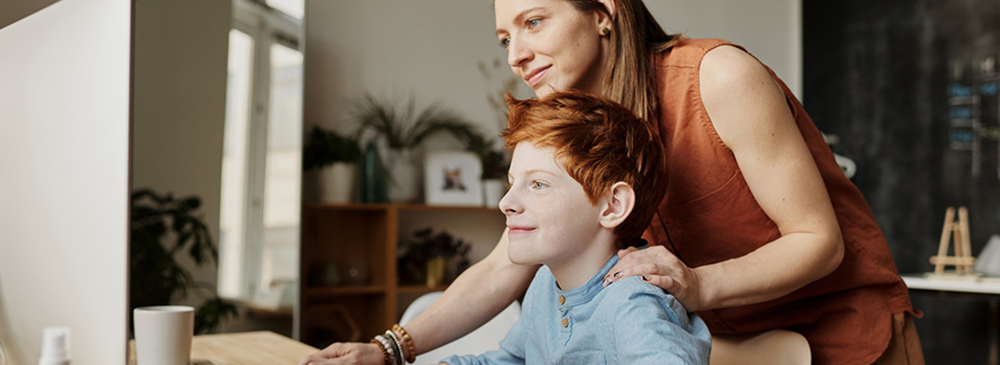
Screen time has increasingly become a part of the everyday life and activities of children—in school, at home, communicating with friends and even at restaurants and on shopping trips with Mom or Dad. With this increase, we want parents to understand the negative effects screen time can have on their child’s vision and its association with nearsightedness (also known as myopia), so they can be on the lookout for any symptoms of blurry distance vision.
While there are many causes of nearsightedness, screen time can play a role in its development. We want to take a deeper look so you can understand the solutions for your child and where to start if you already suspect there’s an issue with your child’s vision.
The pandemic’s impact on children’s myopia
While we were homebound during the COVID-19 pandemic, we often relied on technology for our everyday activities and work, and to entertain us during the long days indoors. A study from JAMA Ophthalmology showed that home confinement during the pandemic appeared to be associated with a substantial increase in myopia development in children 6-8 years old. In fact, the prevalence of nearsightedness in 2020 increased sharply, ranging from 1.4 to 3 times higher than it had been in the previous five years.1 The study also noted that younger children may be more sensitive to environmental changes, given that they’re in a critical period for eye growth and myopia development.1
“Parents of young children are definitely ready to have conversations about screen time,” said Justin Kwan, OD, FAAO, CooperVision Senior Manager of Myopia Management. “We know that the younger children are, the faster their myopia worsens and ultimately, the greater the risk.”2
Screen time and nearsightedness
Can screen time affect my child’s myopia?
In short: yes. Screen time can affect your child’s myopia, especially since kids who are on screens are typically indoors, and reduced time outdoors can have an impact on the development of myopia in children.3,4,5
“Exposure to natural daylight is critical to developing eyes,” Ayesha Malik, OD, pediatric optometrist at Children’s Hospital of Philadelphia (CHOP), said. “Kids need time playing outside for their health, but also for their eyes.”
Studies have found that children who spend more time indoors are more likely to develop myopia. The exact process is still being studied, but researchers believe UV and blue light (as long as the eyes are protected from intense sunlight) plays an important role in healthy eye development. With children spending less time outdoors than they have in the past, the rate of nearsightedness in children has increased dramatically in the past 30 years.6
In a 2022 article in The Atlantic titled “The Myopia Generation: Why do so many kids need glasses now?,” author Sarah Zhang notes that we may not know exactly how “ogling screens all day and spending so much time indoors are affecting us, or which is doing more damage, but we do know that myopia is a clear consequence of living at odds with our biology. The optometrists I spoke with all said they try to push better vision habits, such as limiting screen time and playing outside.”7
Screens are impacting more than just your child’s eyes
If you’re asking “Are tablets bad for my children’s eyes?”—we know screen time is linked to higher rates of nearsightedness. The American Academy of Pediatrics discourages media use by children younger than 2 years old and recommends limiting older children’s screen time to no more than one or two hours a day.4 In addition to vision problems, too much screen time can also be linked to other health conditions or problems, such as obesity, irregular sleep, behavioral problems, impaired academic performance, and less time for play. There are many benefits to limited screen time—both for your child’s eyes and for general health.8
Your child’s total screen time might be greater than you realize. It’s therefore important to start monitoring it now.7 There are even apps to objectively quantify daily screen time and prompts to take breaks or stop entirely. Replacing screen time with fun activities is a win-win for the child.
Signs that screens are accelerating your child’s nearsightedness
There are signs and symptoms that show screen time may be accelerating your child’s nearsightedness progression and could have an impact on eye and vision development.
The very first thing you can do for your child’s eyesight is to know what signs to look for. Is there a struggle to see the board at school? Do you notice your child squinting when looking at objects in the distance or watching TV? Is your child mentioning sudden blurred vision or headaches?
If so, myopia could be the cause.
What you can do about your child’s myopia
Though screen time and tablets are part of children’s everyday lives, there are things parents can do to prevent and stay ahead of a potential myopia diagnosis. Parents are encouraged to schedule annual comprehensive eye exams and observe children and monitor for any behaviors related to screen time, such as excessive time indoors, or squinting while watching TV.
In addition, Dr. Kwan recommends taking children on errands to get them moving and off screens to help reduce the risk of developing myopia. Even in that short time, they’ll be outside a little more than they would be otherwise.
Proven solutions for parents
It might be hard to change screen-time habits. But minimizing—or eliminating—screens from your child’s daily routine can bring many benefits when it comes to your child’s vision and eye health.
If the eye doctor determines your child is struggling with myopia, one option is MiSight® 1 day. These daily wear, single-use contact lenses are the first and only FDA-approved* soft contact lenses to slow the progression of myopia when prescribed for children 8-12 years old at the initiation of treatment.†‡9
Talk to your eye doctor to determine if your child is a candidate for contact lenses. You can find a MiSight® eye doctor near you and get your free trial of MiSight® contact lenses.
Sign up to learn more about MiSight® 1 day.


