

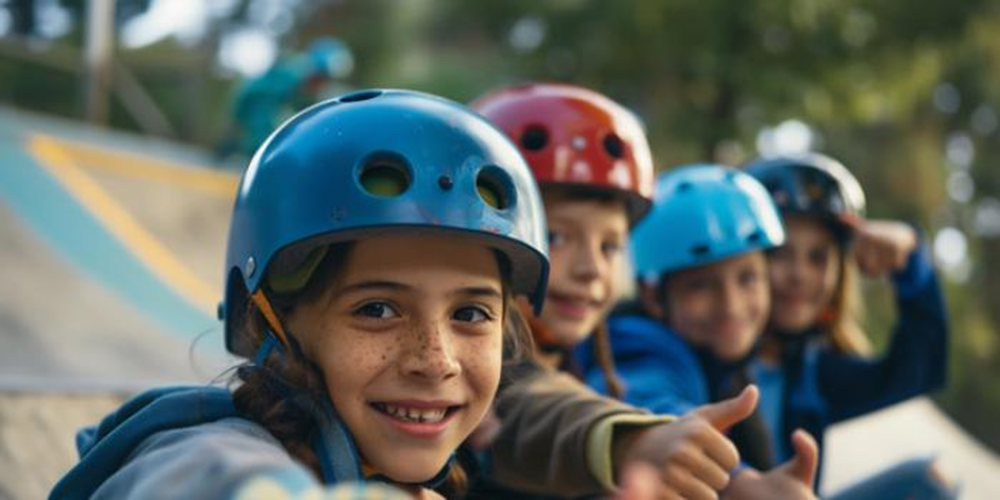
Kids on bikes


As parents, we all want our children to feel confident and happy. One often-overlooked way to boost a child's self-esteem is through vision correction for myopia (also known as nearsightedness). While glasses are a common choice, myopia control with contact lenses can offer significant benefits, especially when it comes to enhancing a child's confidence. This boost in self-esteem can be crucial during the formative years when children are developing their sense of identity.

1. Enhanced Self-Perception

Studies have shown that children who wear contact lenses often feel better about their appearance compared to those who wear glasses.1 According to a study published in the journal Optometry and Vision Science, children aged 8-11 who switched from glasses to contact lenses reported a significant improvement in their self-perception and social acceptance.1

2. Increased Participation in Activities

Contact lenses provide a wider field of vision and are less likely to interfere with physical activities, making them an excellent choice for active kids with blurry distance vision. Research indicates that children who wear contact lenses are more likely to participate in sports and other extracurricular activities.2

This increased participation not only helps in physical development but also fosters a sense of belonging and teamwork, further enhancing their confidence.

3. Positive Social Interactions

Wearing contact lenses can positively impact a child's social interactions. A survey conducted by the American Optometric Association found that 70% of children who wore contact lenses felt more confident in social settings.3

This confidence can lead to better communication skills and stronger friendships, both essential components for healthy emotional and social development.

4. Contributions to Improved Academic Performance

Confidence in one's appearance and abilities can translate into better academic performance.

One study found that students with uncorrected visual deficits had reduced focus, perseverance, and class participation, affecting academic functioning and psychosocial stress.4 After receiving corrective lenses, improvements were seen in classroom attention, task persistence, and willingness to practice academic skills.4


5. Statistics Speak Volumes

  • 25.3% of children aged 2-17 years wear glasses or contact lenses.3
  • Approximately 14.5% of all children under 17 years wear contact lenses.5
  • Children under 12 years old are most frequently prescribed daily disposable soft contact lenses.5
  • 90% of children as young as 8 years old can insert and remove their contact lenses.§8


Conclusion

Choosing contact lenses for your child can be a simple yet effective way to help your child see the world more clearly and confidently.

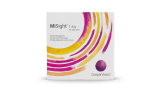
Better yet, MiSight® 1 day contact lenses are the only myopia control treatment to offer a two in one benefit that can correct their blurry vision today AND help protect it from getting worse as they grow.*†‡6,7

Consult with an eye care professional to determine the best vision correction option for your child, and be sure to ask about the unique benefits of MiSight® 1 day.

Sign up for new information about MiSight® 1 day.

* INDICATIONS AND BRIEF SAFETY INFORMATION for MiSight® 1 day soft contact lens:

INDICATIONS:
MiSight® 1 Day (omafilcon A) Soft (Hydrophilic) Contact Lenses for Daily Wear is a prescription device indicated for the correction of nearsightedness and for slowing the progression of nearsightedness in children with non-diseased eyes, who at the initiation of treatment are 8-12 years of age and have a refraction of -0.75 to -4.00 diopters (spherical equivalent) with ≤ 0.75 diopters of astigmatism

BRIEF SAFETY INFORMATION:

Rx only; results may vary.

ATTENTION: Reference MiSight.com/safety for a complete listing of Indications and Important Safety Information.

INDICATIONS: MiSight® 1 day (omafilcon A) soft (hydrophilic) contact lenses for daily wear are indicated for the correction of myopic ametropia and for slowing the progression of myopia in children with non-diseased eyes, who at the initiation of treatment are 8-12 years of age and have a refraction of -0.75 to -4.00 diopters (spherical equivalent) with ≤ 0.75 diopters of astigmatism.  The lens is to be discarded after each removal.

WARNINGS: Problems with contact lenses could result in serious injury to the eye.  Do not expose contact lenses to water while wearing them.  Under certain circumstances MiSight® lenses optical design can cause reduced image contrast/ghosting/halo/glare in some patients that may cause difficulty with certain visually-demanding tasks.

PRECAUTIONS: Daily wear single use only.  Patient should always dispose when lenses are removed.  No overnight wear.  Patients should exercise extra care if performing potentially hazardous activities.

ADVERSE EVENTS: Including but not limited to infection/inflammation/ulceration/abrasion of the cornea, other parts of the eye or eyelids.  Some of these adverse reactions can cause permanent or temporary loss of vision.  If you notice any of the stated in your child, immediately have your child remove the lenses and contact your eye care professional.

‡‡ National rebate: *Available on purchases between 1/1/26-12/31/26. Must submit rebate form within 60 days of lens purchase.

† ActivControl® technology in MiSight® 1 day contact lenses slows axial length elongation and corrects refractive error for age-appropriate children.
‡ MiSight® 1 day, designed for myopia control, shows sustained slowing of eye growth over time on average. While eyes are still growing; children fit ages 8-12 and followed for 6-years. n=40.
§ By 1 month. As reported by parents.

References:

1 Walline, Jeffrey J.*; Jones, Lisa A.†; Sinnott, Loraine‡; Chitkara, Monica§; Coffey, Bradley∥; Jackson, John Mark¶; Manny, Ruth E.*; Rah, Marjorie J.*; Prinstein, Mitchell J. PhD‡ the ACHIEVE Study Group. Randomized Trial of the Effect of Contact Lens Wear on Self-Perception in Children. Optometry and Vision Science 86(3):p 222-232, March 2009.
2 QuickStats: Percentage of Children Aged 2–17 Years Who Wear Glasses or Contact Lenses, by Sex and Age Group — National Health Interview Survey, United States, 2019. MMWR Morb Mortal Wkly Rep 2021;70:865.
3 American Optometric Association. "Contact Lenses Worthwhile Option for Preteens, Children." Optometry and Vision Science, 19 July 2017, www.aoa.org/news/clinical-eye-care/health-and-wellness/children-and-contact-lenses.
4 Dudovitz RN, Izadpanah N, Chung PJ, Slusser W. Parent, Teacher, and Student Perspectives on How Corrective Lenses Improve Child Wellbeing and School Function. Matern Child Health J. 2016 May;20(5):974-83. doi: 10.1007/s10995-015-1882-z. PMID: 26649878; PMCID: PMC4826825.
5 "Can Kids Wear Contact Lenses?"Optometrists.org, https://www.optometrists.org/childrens-vision/guide-to-childrens-eye-exams/can-kids-wear-contact-lenses/. Accessed 21 Feb. 2025.
6 Chamberlain P, et al. A 3-year randomized clinical trial of MiSight® lenses for myopia control. Optom Vis Sci. 2019; 96(8):556-567.
7 Chamberlain P et al. Long-Term Effect of Dual-Focus Contact Lenses on Myopia Progression in Children: A 6-year Multicenter Clinical Trial. Optom Vis Sci 2022 In Press.
8 CVI data on file 2018. MiSight 1 day 3-year study report.

More Blog Posts