



Myopia Is Now Being Treated as a Disease: What Families Need to Know
If your child has been diagnosed with myopia, or nearsightedness, you've probably been told they need glasses or contact lenses to see clearly. For many parents, that seems straightforward: vision gets blurry, a prescription gets stronger, and life goes on.
But a recent shift in how healthcare professionals view myopia is changing that conversation.
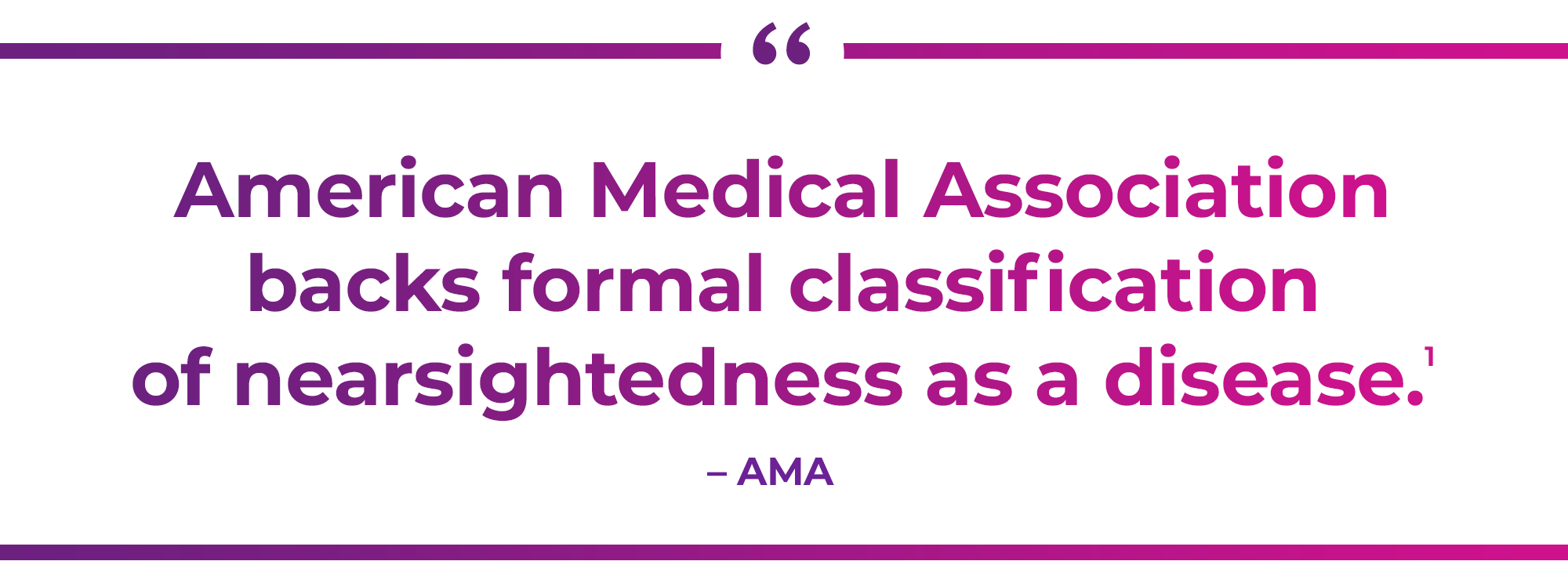
In 2026, the American Medical Association (AMA) officially supported classifying myopia as a disease rather than simply a refractive error.1 While that may sound alarming at first, it doesn't mean your child is sick. It means doctors are increasingly recognizing something important: myopia is a condition that can progress over time and may affect long-term eye health.2
Why the Change Matters
For years, myopia was often treated as an inconvenience rather than a health concern. A child's prescription would increase, new glasses would be prescribed, and families would return the following year for another exam.
Today, we know that myopia is much more than blurry distance vision.
As myopia progresses, the eye grows longer than normal. These structural changes can increase the risk of serious eye health complications later in life, including retinal detachment, myopic macular degeneration, cataracts, and glaucoma.3-6
Myopia Increases the Risk of Serious, Sight-Threatening Complications
Source: Review of Myopia Management
Note: Odds ratio of ocular disease as a function of myopia relative to emmetropia.4
| Eye Disease | Prescription | |||
|---|---|---|---|---|
| -2.00 D | -4.00 D | -6.00 D | -8.00 D | |
| Myopic Maculopathy7 | 2.2× higher | 9.7× higher | 40.6× higher | 126.8× higher |
| Retinal Detachment8 | 3.1× higher | 9.0× higher | 21.5× higher | 44.2× higher |
| Posterior Subcapsular (PSC) Cataract9 | 1.6× higher | 3.2× higher | 5.4× higher | 12.3× higher |
| Glaucoma10 | 1.7× higher | 2.5× higher | 2.5× higher | N/A |
That means the goal isn't simply helping a child see the board at school. The goal is helping to preserve their vision for decades to come.
Traditional Glasses Correct Vision. They Don't Slow Myopia.
One of the most common misconceptions among parents is that if their child can see clearly with glasses, the problem has been solved.
The reality is that traditional glasses and traditional contact lenses correct blurry vision, but they do not address the progression of myopia itself.
Think of it this way: A child with progressing myopia may be seeing 20/20 in their glasses while their prescription continues to worsen year after year. Their vision is corrected, but the underlying condition is still advancing.
This is one of the biggest reasons eye care professionals have begun talking to families about myopia management instead of simply vision correction.
What Is Myopia Management?
Myopia management refers to evidence-based treatments designed to slow the progression of myopia in children. Not every child needs the same treatment plan, but every child with progressing myopia deserves a conversation about their risks and available options.
Why Parents Should Consider Treatment Earlier Rather Than Later
Many parents understandably wonder whether they should wait until their child's prescription becomes worse before considering treatment.
The challenge is that once myopia progresses, those changes cannot be reversed.11
Managing myopia early may help slow progression before higher levels of myopia develop. The less myopia a child accumulates throughout childhood, the lower their lifetime risk of associated eye health complications.
That's why many eye care professionals compare myopia management to preventive healthcare. The focus is not only on today's vision, but on reducing future risk.2
Questions Every Parent Should Ask
If your child's prescription has changed recently, consider asking your eye doctor:
- Is my child's myopia progressing?
- How quickly has their prescription changed?
- Is their eye growth being monitored?
- What treatment options are available to help slow progression?
- What benefits and risks should we consider?
Having these conversations can help you make informed decisions about your child's eye health rather than simply reacting to stronger prescriptions year after year.
The Bottom Line
The AMA's decision to recognize myopia as a disease reflects what eye care professionals have been learning for years: myopia is more than a vision problem.
For parents, that means looking beyond whether your child can see clearly today and considering what their eyesight may look like tomorrow.
A stronger prescription doesn't have to be viewed as an inevitable part of childhood. With today's myopia management options, families have opportunities to take a more proactive approach.
Because when it comes to your child's vision, seeing clearly is important. Protecting their long-term eye health may be even more important.

Learn more about MiSight® 1 day contact lenses
FAQs, parent resources, special offers and savings


